Monday, 27 May 2013

1851 Religious Census of Scotland - surviving returns

A couple of years ago I blogged details from the 1851 religious worship census for Scotland, showing how just four years before the advent of civil registration there were some 904 Church of Scotland congregations in the country (which had made a census return), but some 2122 congregations from other denominations in the country that were not the official state church (see http://walkingineternity.blogspot.co.uk/2011/02/how-many-scottish-church-denominations.html).  The importance of this lies with the fact that often people cannot find an ancestor's marriage or baptism pre-1855 on the ScotlandsPeople website (www.scotlandspeople.gov.uk) - the reason being that ScotlandsPeople only hosts pre-1855 parish records for the Church of Scotland and the Roman Catholic Church, Of the 2122 number, only 104 congregations were Roman Catholic, with some two thousand congregations missing from that period altogether on the website.

In my post I quoted from a summary for the 1851 religious worship census, found on the Histpop website, for a very simple reason. The Scottish returns from that census no longer exist. This is a real frustration, when you consider that not only are the English equivalents still in existence, they have actually been digitised and made freely available on The National Archives website, within the Digital Microfilms collection at http://discovery.nationalarchives.gov.uk/SearchUI/details?Uri=C8993.

As an Ulsterman, I'm long used to the idea that censuses can be destroyed by the simple whims of Government. Ireland is by far the biggest offender, but even in Scotland we have our moments - the household schedules for the 1911 census in Scotland no longer exist, for example, unlike those for the rest of the British Isles, with only the enumerators' returns available on ScotlandsPeople. The 1911 revelation was quite a shock when I first heard of it, but I had long believed that the 1851 religious census for Scotland was a dead duck, with no surviving examples.

Except for the fact that I have now found a couple of examples! Buried amongst the kirk session papers for Speymouth are two printed census forms that have been filled in by hand. I have yet to see whether this means that they were never returned, or whether they are simple copies, but they do provide an interesting glimpse into a record largely now destroyed in Scotland. The returns are for two congregations - Speymouth, and Garmouth Preaching Station, both in Morayshire, both catalogued by the NRS under CH2/839/20.

Officially the census forms were entitled Census of the Population, 1851 Scotland: Return Relating to Public Worship. They each asked nine main questions of the person tasked with filling out the form.

1) Name and Description of Church or Chapel
2) Where situated?
3) When opened for worship?
4) How or why by whom erected?
5) Stipend of Minister?
6) The number of free sittings, and those requiring payment?
7) Estimated Number of Attendants on March 30, 1851?
8) Remarks - any observations in support of the return
9) Signature - of the Minister, Elder, Session Clerk or other duly delegated person to fill the form out.

From the Garmouth Preaching Station return we learn that it was located at Garmouth, being a quoad sacra district of Speymouth parish in Elginshire (Morayshire). It opened in 1849 "for worship in a school in the village, and designed to accommodate those unable to attend the parish church". The station "was erected by His Grace the Duke of Gordon & others for a school". There were 200 free sittings (no others), and normally 180 people attended a service, though none was held on that particular March 30th. Under Remarks the entry notes "There is service during 7 or 8 months of the year in this place, but not in winter owing to want of accommodation". The entry was signed by the minister.

For Speymouth, we get considerably more detail. The church was opened "before 1800", and "when the suppressed parishes of Dipple & Essel (sic) were united by decreet of Court of Teinds into one parish named Speymouth, about 1730". For the salary question for the minister the grain stipend due to him was just over £82, and a money stipend just over £53. The glebe was worth £19 and money for the manse set at £8. Of the church's available seats, only 70 were free, with some 600 other sittings to be leased. On the day of the census 212 members of the congregation attended morning service, and some 18 Sunday Scholars, slightly less than the average number, usually being 280, with 20 scholars. In the remarks section it notes "The charge of this parish is a sole one, the present incumbent has only held it for two years byegone; and the stipend is the average for these two years".

So as with anything in genealogy, there are no absolutes. A couple of entries have survived (and if anyone knows of any more, I'd love to hear from you!), it is just unfortunate that such an interesting resource, for the most part, no longer exists.

The two returns above can be consulted at the National Records of Scotland via the Virtual Volumes computer system, or at various archives across the country via the Scottish Documents platform.

For more on Scottish churches, their history and records, my book Discover Scottish Church Records is available from http://www.gould.com.au/Discover-Scottish-Church-Records-p/utp0281.htm or in a slightly cheaper ebook edition from http://www.gen-ebooks.com.

Chris

Wednesday, 22 May 2013

Seventeenth century medical care

Before the NHS, a classic example of private health treatment from 1692, courtesy of the kirk session minutes from the Perthshire parish of Aberdalgie:

Septe[mbe]r ye 11th    
After sermon sess[ion] met[.]    This day Issobell Firskin in ye Milton of Aberdalgie shewing that through ane extraordinary swelling in one of her fingers she was in hazard to lose her whole hand if ye finger was not cut off and yt a person had undertaken to cut off yt finger and remove yt trouble for a certain summ of money and she be[i]ng poor and Indigent desired ye help of ye sess[ion] for yt effect[.]    The sess[ion] considering ys desire did out of sympathy wt yr petitioner appoint a Collec[ti]on to be given her and Intimation to be made ye next Lo[rds] day yranent

(Source - National Records of Scotland: CH2/1613/1/5 Aberdalgie Kirk Session Minutes)

Ouch...!

NB: if you're having problems with reading the above, bear in mind the letter 'y' is being used as a substitute for the old letter known as a 'thorn', which was replaced by 'th' in modern type - so 'ys' = 'this', 'yt' = 'that', 'yranent' = 'thereanent', etc.

More about Scottish church records, what they contain, and how to find them, can be found in my book Discover Scottish Church Records, published by Unlock the Past. For how to research historic illness and other tragic occurrences in the past, consult my book Down and Out in Scotland: Researching Ancestral Tragedy.

Both books are available in print and handy ebook formats - see http://britishgenes.blogspot.co.uk/p/my-books.html for details.

Chris

Sunday, 19 May 2013

Meeting grandad - the meeting I never knew about

I never knew either of my grandfathers.

Ernie Graham
My mother's father, Ernest Graham was born in Belfast in 1922, and was tragically killed in an industrial accident at Pembroke Dock in October 1972, where he was working as a boilermaker. A person who was supposed to be on a job that day did not turn up, and Ernie, on his day off, volunteered to take his place. A scaffold he then worked on suddenly collapsed beneath him, and he tragically fell to his death. I was only 2 years old, and never had the chance to meet him. In recent times, I did manage to hear an echo of his life, via two letters that he wrote in the 1950s. I had written an article about an earlier family generation in the UK's Your Family Tree magazine, and had included a family tree chart showing how I connected to that person via Ernie. A reader recognised his name, and contacted me to inform me that her parents were very great friends of Ernie, her father having worked with him as a boilermaker in Aden. She sent me copies of photos that her parents had taken of my own grandparents - one of which I in fact already owned - and also two letters. The words in the letters not only told me about activities in his life in the 1950s, but also allowed me for the first time to hear his own 'voice'. It was my grandfather talking, not to me, but to a friend from another time and another place.

Charlie Paton, outside his wireless shop in Belfast
My father's father, Charles Paton, was born in Brussels, Belgium in 1905, to two Scottish parents. He survived the occupation of Brussels in the First World War, later moved to Northern Ireland, survived an encounter again with the Germans during the Belfast Blitz, served in the RAF and later worked as a wireless shop manager. I have spent many years finding out about Charlie also, and have even been to Belgium to trace his war story there as a child civilian, having been enthralled by his life story. My father did not get on with him, however, and I sadly never got to meet him, particularly tragic as I returned from Britain to live in Northern Ireland in 1979, and never knew that Charlie lived down the road from us in Donaghadee. He died in 1987, when I was 17, and I have often wondered if I could have visited him if I had known he was so close. But a meeting with him was sadly not to be either.

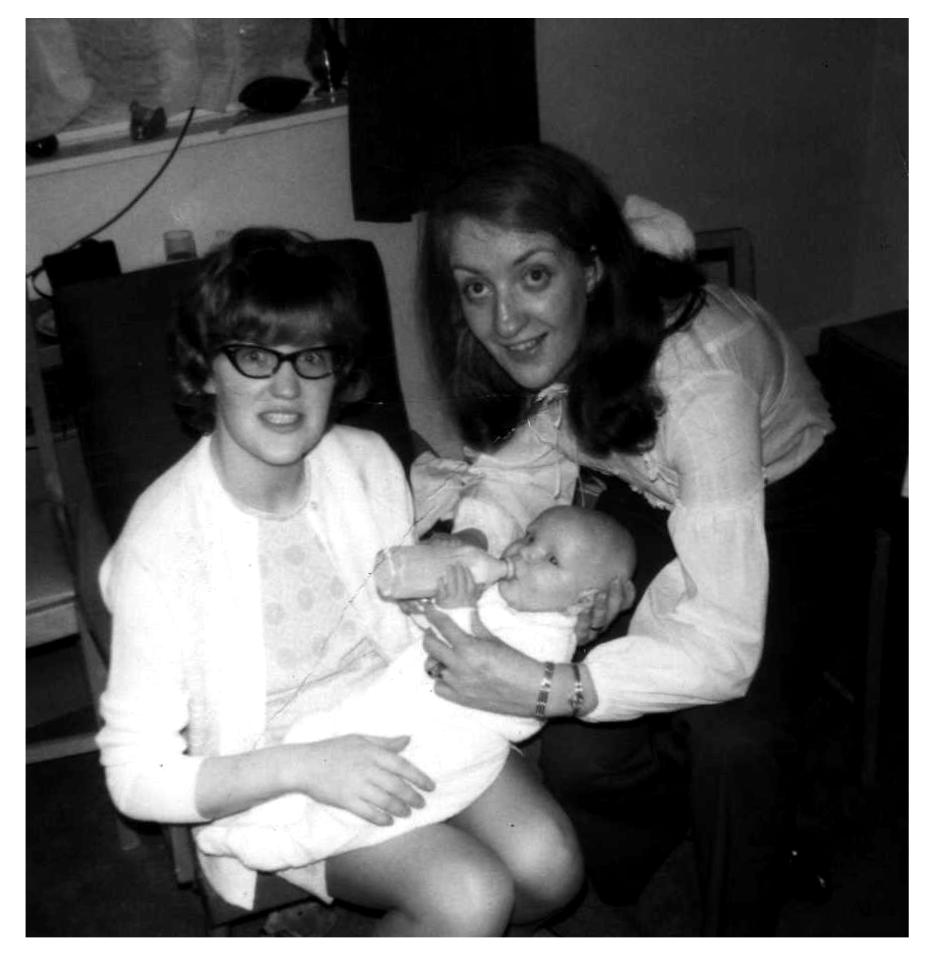
Or so I thought... I am just back from a visit to Manchester to visit my mother, currently in hospital for a treatment - and she has just told me, out of the blue, that she actually met him in 1971, myself in tow. We were living in Scotland at the time, and she had returned home to see my aunt Sheila following my christening in Helensburgh, who had then taken her down to Donaghadee, along with my infant self, to see him. So it turns out, 13 years after I first started researching my family tree, that I now learn that I did in fact meet one of the ancestors I have always wanted to know more about.

I have met one of my grandfathers, but what I know of him now still comes from a pile of documents and recollections of others. I have heard the voice of another from an echo on a few sheets of papers from half a century before, but in a conversation to someone else.

But what I wouldn't give to trade all those documents for a ten minute chat with either of them today.

Sunday, 12 May 2013

Tailzies in Skelmorlie

(The following is something I published a couple of years back - I was intending to update it, but some bizarre Google formatting would not go, so instead I have just republished it as a new post!)

Just down the road from where I live in Largs is a small village called Skelmorlie, right on the border between the historic counties of Ayrshire and Renfrewshire. The following account describes how the lands of Skelmorlie were 'entailed' through a device known as a 'tailzie', and how the terms of the tailzie were redefined by subsequent generations. To set the scene, a wee bit first about the use of tailzies within inheritance from a book I had published in 2010, Researching Scottish Family History:

"A landowner could actually dictate the course of his land’s disposal long after his death by creating a deed called a tailzie, through which he could lay down a series of conditions that had to be adhered to. The breach of such conditions could actually force his successor to give up the land altogether. Tailzies can be extremely useful in identifying entire families, as they would list the name of the person to whom the land should go upon the death of the present incumbent, but also suggest alternative lines should that person die."

Also

"Often within a tailzie, if the line of inheritance should fall onto a daughter or other female member of the family, a condition would be set whereby she could only inherit the land if she first married somebody with the same surname as the creator of the tailzie, or somebody who would be willing to take on that name. In addition, that husband would also have to assume the set of Arms inherited by his wife, and in effect legally become a member of that family as if he had done so from birth. This would allow the identity of that family, and more importantly, the political weight of that family name, to remain undiminished in an area. Such arrangements were recorded in the Register of Tailzies from 1688... Land could be removed from a tailzie, or ‘disentailed’, from 1848 onwards, the details of which are also included in the register."

OK, here goes then - back to Skelmorlie!

On August 27th 1728 Hugh Montgomerie entailed the vicarage teinds and ten pound lands of Skelmorlie, along with additional lands in Renfrewshire at Lochliboside, Hartfield and Ormsheugh. The tailzie decreed the land should go back to his nephew, Sir Robert, Baronet, and then on to Robert's eldest male heir; but if the male lines failed, to continue to the first female line and then to her first male heir, etc. The heirs-entailed were to adopt the name of ‘Montgomerie of Skelmorlie’ and to use the family arms. When Sir Robert predeceased his uncle in 1731, the land soon found its way to his eldest daughter, Lilias Montgomerie.

Lilias was subsequently able to dispose of Lochliboside and Hartfield through an Act of Parliament granted in 1757. As they were entailed, a condition of the sale was that any money raised would have to be used to purchase lands contiguous to Skelmorlie, to then be entailed in place of the original land. To satisfy this condition, she purchased the lands of Coilsfield from her husband, Alexander Montgomerie, and in November 1757 a new deed was drawn up by the couple entailing these lands together.

In June 1774, Lilias executed a further deed in favour of her eldest son Hugh Montgomerie, Esq, Captain in the 1st Regiment of Foot, granting him and his heirs the lands of “the vicarage teinds of Skelmorlie and Montgomerie, the ten pound land of old extent of Skelmorlie, the lands of Ormandsheugh” and the “lands and estate of Coilfield”. This was never entered into the Register of Tailzies, but Hugh Montgomerie (later to inherit the Earldom of Eglinton in 1796 from a third cousin), became infeft under it in June 1774, as confirmed in a sasine in August later that year. Hugh further obtained a charter in 1784, confirming the deed of 1757 regarding the purchase of Coilfield and the disposal of Lochliboside and Hartfield, which also reconfirmed the deed of 1774. He continued to live within Skelmorlie until his death in December 1819.

Hugh Montgomerie was succeeded as Earl of Eglinton by his grandson, Archibald, who inherited both the village and the main Skelmorlie estate. Upon considering the legality of his grandfather’s deed of 1774, which he deemed to be the creation of a new title separate to that described in the previous tailzie set down by Lilias Montgomerie, and as it had not been registered within the Register of Tailzies, he felt bold enough to be able to sell not just the land of Coilfield, in 1838, but also his lands in Skelmorlie in the following year.

As the lands were believed by others to have been entailed under the earlier tailzies, Hugh's actions were challenged but his judgement on the validity of the 1774 charter was upheld by the Court of Appeal in 1843, which decreed that the document's wording was broad enough to allow for acts of sale. It therefore agreed that he could dispose of the lands and that the profits from the sales did not have to be reinvested into the purchase of new lands. The land was effectively disentailed 5 years before a new act of parliament made such an action a lot easier.

So that's a wee bit on the shenanigans that could surround tailzies!

Some recommended reading on Skelmorlie's history and the above case:

ANON. (1791-99) The Parish of Largs, By a Friend to Statistical Enquiries, Sinclair, Sir John.

BELL, S. S. (1843) Cases Decided in the House of Lords on Appeal from the Courts of Scotland, Session of Parliament 1843, Vol. 2, The House of Lords.

DOW, R. J. (1842) The Parish of Largs, Presbytery of Greenock, Synod of Glasgow and Ayr, William Blackwood and Sons, Edinburgh and London.

GROOME, F. H. (1882-84) Ordnance Gazetteer of Scotland. Edinburgh, T. C. Jack.

PATERSON, J. (1852) History of the County of Ayr with a Genealogical Account of the families of Ayrshire.

SMART, W. (1968a) Skelmorlie: The Story of the Parish Consisting of Skelmorlie and Wemyss Bay. The Skelmorlie and Wemyss Bay Community Centre.


NB: For more on the world of Scottish land and property inheritance, read my book Discover Scottish Land Records - available in print from www.gould.com.au/Discover-Scottish-Land-Records-p/utp0283.htm or as an ebook from www.gen-ebooks.com.

Chris

Wednesday, 8 May 2013

All hail the conquering heir...!

So you've read the books, and they tell you that Scotland is a wee bit different to the rest of the UK in how land was inherited - for one thing, land could not be conveyed in a Scottish will until 1868, three centuries after the same thing happened in England. You may also be aware that as such, one possible and very separate way to formally inherit land was to go through a process called the Services of Heirs, whereby a jury confirmed who you said you were, before you could take possession of the inheritance.

So far so good... except, that this does not even begin to cover the many potential complexities surrounding the issue of inheritance!

Take, for example, conquest. By that I don't mean a person going out with a warhammer and clubbing his enemies into submission, but the Scottish legal term for a specific part of the property or land that an heir might inherit. Land that had previously been inherited from a relative or ancestor was known as heritage - but land that was purchased in a person's lifetime, received as a gift, or even obtained by way of an exchange (excambion), had the very different designation of conquest. And in certain circumstances, the person who inherited the conquest was not necessarily the person who inherited the heritage.

Under Scots Law, land was historically conveyed to an heir since the days of old, when the knights were bold, via the rules of primogeniture - so to a first born son, but if he died, to the next eldest son, and so on. If there were no sons, it then went to all the surviving daughters in equal shares (they became known as heirs portioners). If the deceased had no children, however, what would then happen to his estate? That's when it gets interesting!

If the deceased had one brother, either younger or older, all the estate - both the heritage and the conquest - went to the other brother. But if the deceased had an older brother and a younger brother, that's when something very unusual happened - the heritage went to the younger brother, as the next heir of line, but the conquest went to the older brother, as the heir of conquest. As a law in Scotland, this continued right up to 1874.

A simple rule summed up the process - heritage descends, conquest ascends.

But what if there were no brothers? Then it went to the uncles - the heritage to the next youngest brother of the deceased's father, the conquest to the next oldest brother of the deceased's father. And there could be many other combinations of the property going in different directions.

Just for good measure - conquest, when it passed to an heir of conquest, was only ever designated as such the once. When the heir of conquest later died, the conquest he had previously inherited in his lifetime would at this point be designated as heritage, and inherited by his heirs through the normal route of primogeniture. The conquest he had personally obtained in his lifetime - by purchase, gift or exchange - would, however, be designated as conquest until it was inherited, and later became heritage in its own right. (Still with me?!)

The bottom line is, never take anything for granted with Scottish genealogical or land history research - it is wonderfully complicated!

For more on Scottish land records and inheritance, my book Discover Scottish Land Records is available in paperback from Gould Genealogy at http://www.gould.com.au/Discover-Scottish-Land-Records-p/utp0283.htm or via PDF format ebook (slightly cheaper and no postage!) at http://www.gen-ebooks.com.

Good hunting!

Chris

Sunday, 27 January 2013

Youthful indiscretion in the First World War

For a few years now I have been working on a project to try to identify those British civilians (and civilians from the British Empire) who were interned at the Ruhleben internment camp near Berlin during the First World War (see http://ruhleben.tripod.com). My interest comes from the fact that my great uncle John Brownlie Paton was interned there in 1916, just a few months after the death of my great grandfather David Hepburn Paton in Brussels in April of that year. My own family story fascinates me no end (but then again, whose doesn't?!) but occasionally I come across wee gems that just add another insightful glimpse into the attitudes of society at that time.

I am currently working through a series of Foreign Office file images from the National Archives at Kew, which contain various lists of people who were interned, as well as some additional details. The files were sourced from FO 369/710. Amongst them was the following tale of a young lad who was living in Germany when the war broke out, and who should have perhaps kept his opinions to himself about the war!

Harold Ewart Crick was one of two lads who in the eyes of the British had been unjustly arrested by the Germans and imprisoned in Berlin. They had been detained as 'seamen' (i.e. merchant seamen). The American Legation, acting as an intermediary for the British with the Germans prior to their own entering the war, was asked to look into his case, with the British summary of his plight as follows:

Harold Ewart Crick. "in prison for making defamatory statements about Germany".

This boy wrote a letter, which under the circumstances must be at least described as foolish, to his mother in this country, and Mrs Crick sent it to the "Times" for publication - without giving the boy's name or address. The German authorities identified the writer, who has since been imprisoned.

Could we not ask that the matter may again be put before the German Government, urging that in view of the period of imprisonment already under-gone by Crick, a sufficient punishment has now been meted out to him for his youthful indiscretion? It may be added that the boy is stated to be very delicate, having been frequently in the hands of doctors for heart trouble, and that he is also of an epileptic tendency. 

For good measure, the newspaper clipping from October 9th 1914 is also included, with the offending letter included as follows:

My dear Mother, - At last a chance of writing to you a decent letter. We are quite well here, and as happy as can be expected. The feeling here has undergone a decided change during the last fortnight. At first everybody thought the Germans were going to have a kind of picnic, and that all would be over by Christmas. Now, however, they are not nearly so hopeful. We hear the wildest stories about the brutalism and cowardice of the British troops, which everybody believes. They call every battle a victory here, which, if it wasn't so sickening, would be amusing.

Here everything is going on as if there was no war at all, except that we are overrun with soldiers. We have two quartered on us; they are very decent fellows, their patriotism being conspicuous by its absence.

You may depend upon it that the very day after peace has been signed aunt and I will go to E.; we are quite fed up with these dirty self-righteous Germans.

According to their papers the only army which contains any brave men is the German. Whenever they lose, it is by the meanness of the British, who have no respect for the laws of humanity or any other laws.

They bate us most. They say we forced France and Russia to make the war, and are responsible  for every unfortunate happening since the world began, including the Flood. The inhabitants of Sodom and Gomorrah have been proved to be direct ancestors of the British!

Be sure and treasure up the newspapers. If you come across a German be as kind to him as you can. "Heaping coals of fire".

Fortunately, the outcome of the appeal was a happy one for young Harold:

Crick has now been released and has safely returned to England. 

Boys will be boys...!

(With thanks to Simon Fowler)

Chris

Saturday, 19 January 2013

RIP Auntie Sheila

A week ago my father's sister, my aunt Sheila, passed away in Belfast after a seven year battle with cancer. The funeral was on Thursday, but as often the case at such events, you never really get a chance to say how much someone means to you. So I want you all to know about my Aunt Sheila!

Sheila & my father in Eden
Sheila Elizabeth Cobby, nee Paton, was born in Belfast on Valentine's Day in 1943, in the middle of the Second World War. Her father Charlie and mum Jean had been residing in the city's Whitewell area, where two years before their house had been damaged during the Belfast Blitz. Her father, a wireless shop manager, was born in Belgium to two Scots, and spent the First World War in Brussels as a small child during the occupation by the Germans. Her mother, a Glaswegian, was descended from family of an Irish protestant background in Derry, and had only moved to Belfast in the late 1930s. Sheila was the third of four children, with two older brothers Robert and Charlie, and a younger brother Colin, born just after the war.

When her parents separated in the mid 1950s, Sheila and her mum briefly returned to Scotland. They made their way north to Auchterarder in Perthshire, where Sheila's mother (my grandmother) had already obtained work as a domestic servant at the huge Gleneagles Hotel, her job being to supervise the laundry in the hotel etc. Sheila had to stay in the village with a lady called Mrs. King and her son, Charles, and was enrolled into a local school in the town, having to wear a uniform of maroon and grey.

In Carrick
(I once asked Sheila what events made her proud in her life. There were the obvious - her marriage, her daughter, and so on - but she also told me that when she was young in Auchterarder she was always forced to sneak into the back door of Gleneagles Hotel, and up a small stone, spiral staircase to secretly meet up with her mother whenever she could. She was never allowed in through the front door. Years later, she took much pride, when, having won a prestigious golf tournament in Belfast, for which the first prize was a weekend at the Gleneagles Hotel, she could actually walk through the front door of the place as a guest, without any objection from the staff.)

Sheila and her mum returned to Northern Ireland not long after, and when her mum regained custody of the three boys, they all moved to Carrickfergus, further north along the shore of Belfast Lough. They initially stayed in the village of Eden, but not long after relocated to Joymount in the town itself, residing at Robinson's Row. In the late 1950s, Sheila developed polio, and it was believed that she would never walk again in her lifetime. She was treated at Purdysburn Hospital in Belfast, and at one point, when it was believed that the virus had reached her brain, things did not look good for her. She once told me that she remembered the nurses saying that they might have to call her father in to see her for a last time, but fortunately her condition improved and she was discharged from the hospital with a pair of calipers to help her when walking. She overcame her polio with sheer grit and determination.

As a teenager, Sheila worked for Betty Wilson in Dobbins Inn Hotel in Carrickfergus. With the money she earned from here, Sheila was the first to buy a Mini car in the town in the 1960s. She later worked at Dunmore race course.

Wedding - with her father, Colin & Charlie
Sheila later married Allen Cobby, a merchant seaman, in Hull. She gave birth to her daughter when living at Carnmoney, County Antrim, at a place she had bought prior to meeting Allen. About six years later, the family moved to Waterloo Park North just off the Belfast Road in the city's Fortwilliam area. Many years later she also became a grandmother to Australian born Lauren. Sheila worked as a saleswoman all over Ireland, and eventually retired in April 2003. As already mentioned, she loved her golf, and was one of Northern Ireland's top amateur golfers. In the 1980s, she was lady captain of both Carrickfergus Golf Club and Fortwilliam Golf Club in Belfast, and was a member of the Irish Ladies Golf Union.

Sheila had no time for the sectarian nonsense still happening in Ireland - politically she was a member of the Alliance party, with as many Catholic friends as Protestant. When I married my Irish Catholic wife Claire in Kilkenny in 2000, Sheila was the only member of my extended family to bother coming to the service from Northern Ireland - and in Kilkenny today my wife's brothers still toast "Auntie Sheila", she made quite an impact! Nobody told Sheila where the boundaries were, she was capable of making her own mind up in such matters. In that regard she was a true hero, and there are not enough like her.

Overall, if there is one word that describes Sheila's approach to life it was a 'grafter' - she worked hard to get where she got to, overcoming extraordinary odds and challenges.

Sheila at my wedding in June 2000
When I was baptised on the submarine HMS Churchill in January 1971, Sheila was there as my godmother.  When my parents split up in the late 1970s, and my brother and I returned to Northern Ireland with my father, it was Sheila who came and picked us up from the ferry. As lady captain in Carrickfergus Golf Club, it was my aunt Sheila who first introduced me to scampi in a basket! When I gained a place at university in Bristol in 1991, for various reasons I was unable to get funding for my first year. I took a job in Belfast as a security guard to save up to pay my fees, and Sheila put me up in her house for the summer. When I worked a 12 hour shift, and sometimes 24, I would return to her house to find something in a pot on the stove and the electric blanket in the bedroom I was staying in always switched on. When my first son Calum was born, it was she who bought him his first soft toy, a wee blue rabbit called "Floppity"!

I can hear her now - "Now Christopher, let me tell you, have you nothing better to be doing with your time than writing all this nonsense?"

RIP Auntie Sheila, you will be much missed...

And make way Big Yin, there's a Paton coming - and she'll be making sure your handicap gets better on the big celestial golf course in the sky!

Carrick Golf Club Ladies annual dinner, abt 1981
After my christening in Helensburgh
Ladies Captain's Day at Carrickfergus Golf Club, 1981
On a winning streak!